I have embraced the life of devotion to the high power of existence since I was a child. I did it in the face of a battle between the two sides of my family being of different faiths, different churches. Different.
My mother was Roman Catholic and my father’s family, where we lived far from mother’s birth world, was evangelical Protestant, etc. In the backward worlds of my childhood, the taunts and jeers happened at church camp — “Your mother’s going to hell” — and this wasn’t to be taken lightly considering what we were taught about hell.
And I was distraught over it. Like when my kitten died, froze to death actually, being on the wrong side of the kitchen door. (Whose fault that was remains a mystery 70 years later but my money was on …) When my kitten died I was sobbing because the mean child up the street said animals didn’t go to heaven. Daddy Paw assured me the kitten was in heaven and yes, my mother would go there too.
A family court judge in Jefferson County did not weigh in on heaven or hell but did say that I would have every other weekend with my mother and I would go to church on Sunday with her and at the church of her choice.

So I am dual. A dualist in many ways. Reared, predominantly, in a Fundamentalist Nazarene community, on my paternal grandmother’s side; they who had been staunch Methodists since our earliest 19th century records. Paw was a believer and gave me permission to follow my heart. I remain steadfast in the believe and practice of spiritual love of everyone through the word of G-d.
Hellfire and brimstone sermons are the ones I remember from the earliest days of wiggling around in the pews. Yes, yes G-d is love and Jesus is the way, the truth and the life. But to get there, one hears, “Sinner, sinner, sinner, repent.” And I did.
The evangelical works churches did not have “once saved, always saved.” You could and did lose your salvation for nothing but a nasty thought. If you don’t believe me, ask Jimmy Carter; he knew about thinking sin. This repeat sinning results in getting saved again and again, and by the time one is “of age” the number of times I was baptized is more than I wish to try to count.
Seeing from birth this fight between religious factions made me different from many around me. I was born in 1952; my visitation, church order, happened in 1962; and by 1963 my hometown had become a center of strife. Integration in Birmingham had begun and Black people were going to White places, schools, restaurants, churches and more.
Horribly, shamefully, criminally and morally bankrupt Whites went to Blacks’ places and blew up homes. And they blew up churches, killing little girls — little girls my age.
Oh yes, religion was touted. The White preachers, paced and ranted like barking dogs: “Those peoples are descendants of Ham.” The White pastors of the love of G-d wanted them de-boned.
But the priest at my mother’s and stepfather’s church lived the love of G-d. He, Father Raya, even stood and marched with the Blacks in Birmingham. He was one of only a small handful of Whites who walked in Birmingham with the Black community.
(I wish I and all the children of Birmingham – all sides — had had a program to help children.)
Fast forward through four continents, living in a half-dozen different countries, Gulf One, and more and 70 years later, I declare there are more ways to have a religion for every denomination than there are Carter’s little pills. Thousands of different Methodists and Baptists and Anglicans and Melkites and Romans and Shias and Sunnis and more and more
The ugliest belief systems are those of sects whose people say: “I know the right interpretation and my way is the only way.”
War – how many dead?
Damn – and all in the name of the same evolved Higher Power.
Don’t say a word to me about spirituality, faith, devotion. I remain steadfast. I remain a believer and worship — and I have not killed anyone, not even in the name of G-d.
War — while we adults fight over who is right, fight to settle scores and get justice, the next generation needs to be spared. Somehow.
Maybe there is no point. Whether Memphis or Gaza, whether black, white or brown, whether ancient history or herstory or just another news story passed over – while we adults fights wars
remember the children…
I believe in this program and wish to share its existence with you.
From their page:
“BRIDGING GAPS, TRANSFORMING LIVES.
The International Network for Aid, Relief, and Assistance — INARA is a 501(c)(3) nonprofit organization that provides essential medical and mental health support to children affected by human-induced and natural disasters. Founded in 2015, INARA operates in Lebanon, Palestine, Egypt, Afghanistan, Ukraine, Syria, and Türkiye, with plans to expand into Sudan and Yemen.
Our areas of intervention include comprehensive medical services, mental health and psychosocial support, education in emergencies, economic empowerment, WASH (Water, Sanitation, and Hygiene) initiatives, and rapid emergency response. INARA emphasizes long-term care, ensuring that children receive continuous treatment and rehabilitation.
Conflict impacted children struggle to find someone to support them. At INARA, we step in to provide them with the care they need to heal, recover, and move on.
INARA fills programmatic gaps and takes on cases when no other institution can.
We currently sponsor children of all nationalities in our areas of operations who need medical attention and psychological help. We have a team of well-trained caseworkers and mental health professionals ready to step in when needed.”
INARA
Countless memories of Father Raya including mine.
“Archbishop Joseph Raya – Apostle of Peace and Love
Joseph Raya was born in Zahle, Lebanon, on August 15th, 1916, the sixth of seven children in a family of devout Christian Arabs. As a result of his formal education, he quickly attained fluency in Arabic, French, and Greek. Educated in Zahle, Paris, and Jerusalem, he was exposed to a variety of formative experiences and cosmopolitan environments. Ordained a priest on July 20th, 1941, he was assigned to Jerusalem, Zahle, and later Cairo.
In 1944, he became the Director of the Diocesan school in Zahle, a position he held until 1946. He was subsequently transferred to Cairo, Egypt to serve as Supervisor of Studies and Professor of French Literature at the Patriarchal College. Raya believed women should have the right to receive an education[1] and generally defended the dignity of women. Raya advised an Arab woman to slap the face of any man who made inappropriate sexual advances toward her, no matter the man’s rank. When the deserved but insulting slap was delivered to King Farouk, Father Raya was maligned and given twenty four hours to leave Egypt. Had Father Raya failed to heed the warning of King Farouk, he would have faced certain death at the hands of King Farouk’s men.[2]
Settling in the United States of America, Father Joseph Raya mostly served as a priest in Birmingham, Alabama. His sixteen years in Birmingham were characterized by a number of ambitious, but successful undertakings: he promoted vernacular (English) in Byzantine Church services, he engaged in deep interpretive study and activity whereby he reframed many traditional Orthodox theological constructs. For example, he redesigned theological constructs that would negate violence, especially towards Jews. He recognized and responded to various racial, religious, and ethnic inequalities, and became a close personal friend of Martin Luther King Sr. and Martin Luther King Jr. Finally, he supported and embraced their philosophies of non-violent resistance.
In the fall of 1968, Father Joseph M. Raya was consecrated as Archbishop and appointed to the See of Akko, Haifa, Nazareth, and all of Galilee. During this very challenging and complex time in his life, Archbishop Raya attempted to embrace Israeli’s Arab Christians, Moslems, Druze, and Jews as his brothers and sisters. Archbishop Raya sought to find peaceful and loving ways to enhance the dignity, equality, and freedom of all people through a series of bold peace and justice initiatives.
Most notable was Raya’s fight for the return of Ikrit and Kfar-Berem, two Christian Arab villages located within his diocese in northern Israel. On October 31, 1948, the Israeli army entered these two Palestinian villages near the Lebanese border. Approximately one week later, on November 8, 1948, the military requested the entire populace vacate for security purposes with the assurance they could return in less than fifteen days. Years passed but the displaced villagers were not allowed to return to their homes and lands, livelihoods and businesses. With their lives in disarray, the villagers presented their case to the Supreme Court of Israel. On July 31, 1951, after much debate, the Supreme Court of Justice ruled that it was the inalienable right of the Palestinians to return their villages. Unwilling to recognize the court ruling, the Israeli military decided to continue occupancy of the area and ultimately ordered the destruction of the villages. For twenty-four years, the Palestinians lobbied for the implementation of the Court’s decision and the opportunity to return to their shattered homes and lands.
Various individuals and groups shared their concerns with Archbishop Raya, and asked that he investigate and address their causes. Using non-violent means, Raya:” READ MORE….
From arabamerica.com https://www.arabamerica.com/
“…RAYA, ARCHBISHOP JOSEPH M. (1916-2005) Archbishop Joseph M. Raya, former Greek Catholic Metropolitan of Akko, Haifa, Nazareth and all Galilee, died 10 June in hospital in Barry’s Bay, Ontario. Raya, who served in Galilee from 1968 to 1974, was known for his commitment to seeking reconciliation between Jew, Christian and Muslim, for his English translation of the Byzantine Liturgy and for his teaching of Byzantine theology. He has been nominated for this year’s Nobel Peace Prize. Ordained in Jerusalem in 1941, Raya served in Lebanon, Egypt and New Jersey before coming to Birmingham as pastor of St. George Melkite Church 1952-1968. He served as a research aide at Vatican II. He was a friend of Martin Luther King Sr. and Jr. and worked for interracial justice. In Galilee he became a key…”
https://obits.al.com/us/obituaries/birmingham/name/joseph-raya-obituary?id=9117822
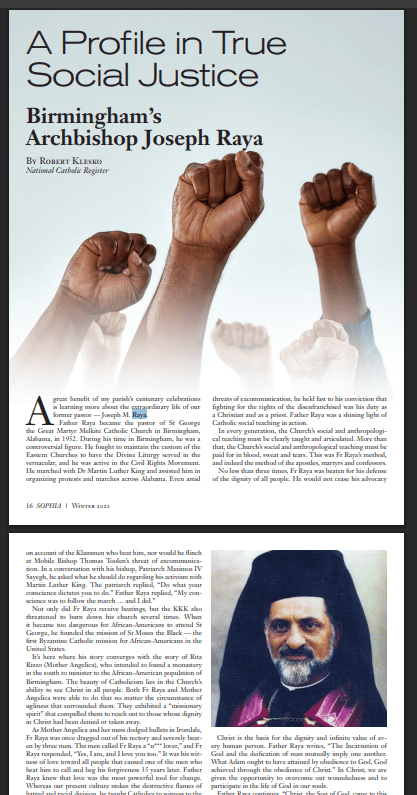
Father Joe
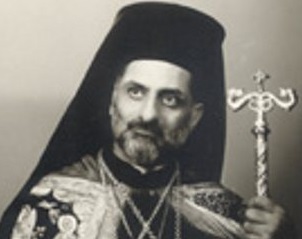
“Archbishop Joseph
Father Joseph M. Raya served as pastor of St. George Melkite Catholic Church in Birmingham, Alabama, from 1952 to 1968. He quickly became known as a priest who lived the Gospel with courage and conviction. He insisted on celebrating the Divine Liturgy in the language of the people so that faith could be accessible to all, to the point of producing many of the initial English translations of the service texts and scripture readings used by Eastern Catholics and Orthodox alike. He became deeply involved in the Civil Rights Movement. Marching alongside Dr. Martin Luther King Jr., Father Raya endured threats, beatings, and even Ku Klux Klan intimidation for his defense of human dignity and equality. When African-Americans could no longer safely attend St. George due to violence, he responded by founding St. Moses the Abyssinian — the first Byzantine Catholic mission in the United States dedicated to African-Americans.
What made Father Raya’s ministry so remarkable was not only his boldness but his love. He met hatred with forgiveness and refused to let fear or violence keep him from his mission. Even when beaten and threatened, he answered with words of compassion, inspiring those around him to see Christ in every person. His witness left a lasting imprint on Birmingham and on the life of the Church, showing what it means to put Catholic social teaching into practice, no matter the cost.
In 1968, Father Raya was named Archbishop of Akko, Haifa, Nazareth, and All Galilee. There, too, he carried his passion for justice and peace, becoming a voice for reconciliation between Jews, Christians, and Muslims, and for the dignity of both Arabs and Jews. He led peaceful demonstrations, fasted before the Knesset, and worked tirelessly for those who had been displaced. His efforts earned him worldwide recognition, including a nomination for the Nobel Peace Prize in 2005. Whether in Alabama or the Middle East, Archbishop Raya’s ministry was marked by the same truth: every human person is made in the image of God and deserves to be treated with love and dignity.”
https://www.saintgeorgeonline.org/clergy


Pingback: The Trinity, Part One: Sabras | Cherie Lynn's Herstory
Pingback: The Trinity, Part Two: …yes, there is a war. But does it have to be fought… | Cherie Lynn's Herstory
Pingback: Parts 1, 2 & 3: Sabras, Wars, Hope – Marionetta Strung-Out